Now under new United States-based ownership, TikTok has updated its privacy policy as of January 22nd, 2026. Many TikTok users have voiced grievances about the personal information that TikTok will be allowed to access and collect.
Recap of the TikTok deal
Students at Marco Island Academy who use the viral social media platform, TikTok, may be familiar with the long and troubled history of the United States-TikTok Deal.
Going as far back as August of 2020, with President Donald Trump’s threats to ban the app across the country in the name of national security, there has been a relentless legal battle between ByteDance (TikTok’s Chinese parent company) and the federal government.
Speculation of a TikTok ban reignited in April of 2024 when President Joe Biden signed a law requiring ByteDance to sell ownership of TikTok to a U.S. buyer by January 19th, 2025, or be banned nationwide. This was met with a lawsuit by TikTok & ByteDance to block the sale, but was ultimately unsuccessful.
President Donald Trump signs an Executive Order, courtesy of the White House gallery and public domain.
On January 18th & 19th, TikTok stopped operating in the country in accordance with the law. However, service was restored when the President-elect Trump announced there would be a delay to re-examine the deal. This extended the deadline.
Again, in April & June, the deadline was extended further for ByteDance and the United States to make a deal. By September 16th, officials from the United States and China agreed on a framework deal to transfer ownership of TikTok to a U.S. buyer. Nine days later, Trump signed Executive Order 14352, formalizing the deal.
On December 18th, 2025, ByteDance confirmed that Oracle would be its U.S. buyer, alongside the companies Silver Lake and MGX, to form a joint venture, TikTok USDS Joint Venture LLC, with a date set for January 22nd, 2026. By the end of the deal, 80.1% of the new entity was owned by American investors, with the remaining 19.9% remaining with Chinese ByteDance.
How are users being affected?
As new ownership has swept over TikTok, so have new app policies and privacy agreements. The most notable of these is the new privacy policy that went into effect on January 22nd. While the privacy policy was recently modified on February 5th to accommodate the California Consumer Privacy Act, there are still many elements that cause concern.
Some students at MIA show little support for the deal. “Considering the political climate currently, I am highly doubtful that this will have positive effects,” one anonymous sophomore told The Wave, “Our government has shown time and time again they are not to be trusted with social matters. I predict that this deal will bring about more censorship and discrimination against minority groups.”
This new privacy policy has caused much distress not only for TikTok users around the globe but also for those at Marco Island Academy, especially concerning the information that TikTok US is able to access and collect about its users.
“I didn’t know that there was a new privacy policy,” an anonymous junior told The Wave. Under the new privacy policy, the Joint Venture entity will be able to collect the following information about its users:
- Name
- Date of birth
- Gender
- Username
- Password
- Phone number
- Race/ethnicity
- Citizenship or immigrant status
- Religious beliefs
- Mental/physical health diagnoses
- Sexual orientation
- Location data (IP address, time zone, precise location data, information of places users visit)
- Financial information (Credit cards, billing address, contact info, purchase history)
- Government-issued identification (Driver’s license, ID card)
- All interactions with on-platform Artificial Intelligence companions/chatbots
- All messages, pictures, videos, or content posted/shared/drafted
- Screentime & app usage
- Information about users’ operating systems (app and file names/types, mobile carrier, battery level, audio settings, bluetooth devices, etc.)
- Faceprints & vocalprints (face-scans and voice scans)
- Information from other affiliates with TikTok USDS Joint Venture
- Information from government sources, businesses, and public sources
Many students are skeptical of the motives behind the collection of this information. “TikTok doesn’t need access to this data, and I think this company, Oracle, is collecting this data not to improve TikTok, but for more dangerous purposes,” an anonymous freshman said.
One junior told The Wave, “I find it ironic that even though the main reason TikTok was banned was because of data concerns with China, while the American TikTok is collecting more personal data than the regular version.”
The Wave’s Findings
In late January, The Wave put out an anonymous school-wide survey to collect the opinions of students on the new TikTok privacy policy. A total of 55 students, Freshmen, Sophomores, Juniors, and Seniors, responded. The results provide a valuable insight into the student body.
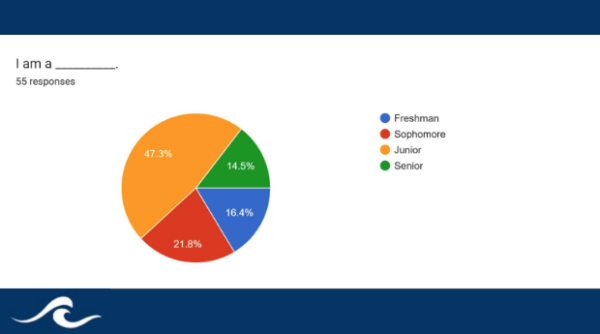
The results of the survey are publicly available.
61% of students surveyed were TikTok users. 13% said they used TikTok at least once a day. 26% use the app several times a day. 24% admitted to using the app “almost constantly.” Over one-third, 38%, claimed not to have TikTok. Of all students surveyed, an overwhelming majority, 83%, were familiar with the prior details of the US TikTok deal.
Students were then asked to rate on a scale of 1 to 5 how comfortable they were with segments from TikTok’s new privacy policy; 1 being Very Uncomfortable, 3 being Neutral, and 5 being Very Comfortable.
For policies relating to the collection of personal data (see #1 – #12 in the list above), the average ratings of the student body come out to “Neutral.” This only faltered when students were asked if they were comfortable with TikTok US collecting this information without being logged in as a user.
61% of students rated “Uncomfortable” to “Very Uncomfortable” when it came to TikTok collecting clipboard content, text, or images that are copied and pasted.
Students averaged as “Comfortable,” 3.6/5 stars, with TikTok US monitoring screen time and app usage, and how frequently users are active on the app.
An overwhelming majority, 85%, felt uncomfortable with TikTok US collecting financial information, and 76% were not comfortable with TikTok US collecting information to verify users’ identity. Furthermore, 78% of students did not support TikTok’s ability to collect locational data.
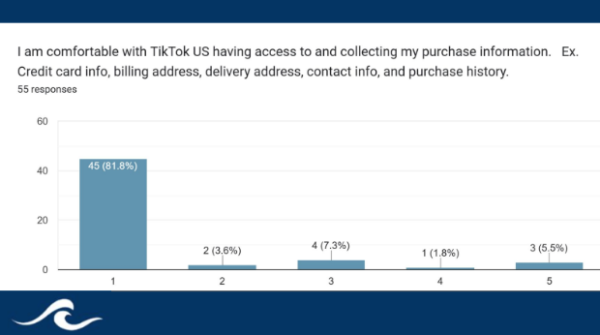
67% of students were uncomfortable with TikTok US’s access to details about users’ operating systems (#19 above), and 78% of students did not like that face-scans and vocal prints could be collected for identification purposes.
“TikTok doesn’t need access to this data,” said one freshman, “and I think this company, Oracle, is collecting this data not to improve TikTok, but for more dangerous purposes.”
Students had an extremely poor reception of TikTok US collecting information about users from third-party sources, such as affiliates with TikTok US, government agencies, businesses, and publicly listed information, with over 60% of respondents rating “Uncomfortable” to “Very Uncomfortable.”
53% of those surveyed stated that these new privacy policies made them feel “Unsafe” to “Very Unsafe.” 44% reported as “Neutral.” Only a single student claimed to feel “Very Safe.”
Despite knowing this information about the privacy policy, 46% of students said they would continue to use TikTok. 37% reaffirmed that they do not use TikTok. 12% were undecided. Only 5%, 3 people, said they would stop using the app.
Some students at MIA remain hopeful about the new policy. “TikTok can be used for good if the people behind it do the right thing,” said sophomore Kaden Petit, “If TikTok took care of its users and… the information shared to the app/website, this would be completely fine… It’s great for allowing users like myself… to dive deep into their beliefs without the app putting it down. TikTok shouldn’t be banned; instead, it should be modified.”