As Collier County continues expanding, a growing legal battle over development and conservation is forcing residents to face a difficult question: how much growth can Southwest Florida sustain before the environment that defines it begins to disappear?
In April 2026, three environmental organizations, the Center for Biological Diversity, the Sierra Club, and the South Florida Wildlands Association, filed a federal lawsuit against the U.S. Fish and Wildlife Service, the U.S. Army Corps of Engineers, and the U.S. Department of the Interior. The groups argue that federal agencies directly violated the Endangered Species Act by approving major developments in eastern Collier County. At the center of the dispute is the Town of Big Cypress, also known as Rural Lands West, a master-planned community slated to bring 10,000 homes and over 2 million square feet of commercial space to the region.
The scale of the project is difficult to ignore. Spanning thousands of acres near the edge of the western Everglades, the proposal includes plans for residential neighborhoods, commercial centers, schools, recreational facilities, and industrial spaces intended to support long-term economic growth. To balance this footprint, the project’s official website highlights a commitment to setting aside “12,000 acres of environmental preservation areas.”
Still, public records reveal the immense friction between the developer’s vision and local zoning laws. In its application documents posted to the Collier County Growth Management Department’s public portal, developer Collier Enterprises requested 51 distinct deviations from the county’s land development code. These requests range from altering roadway standards and landscaping requirements to modifying regulations on density, mixed-use planning, signage, setbacks, and infrastructure.
While the sheer number of deviations underscores how dramatically the project departs from traditional rural development patterns in eastern Collier County, some contend the exceptions are a logistical necessity. Proponents argue that waivers are required to build a self-sustaining, master-planned community in a remote area completely lacking existing municipal infrastructure.
Supporters perceive the project as an essential evolution for a region whose population continues to climb rapidly each year. Conversely, environmental advocates argue that the consequences extend far beyond a single housing development, insisting that superficial acreage allotments cannot mitigate the developer’s defects.
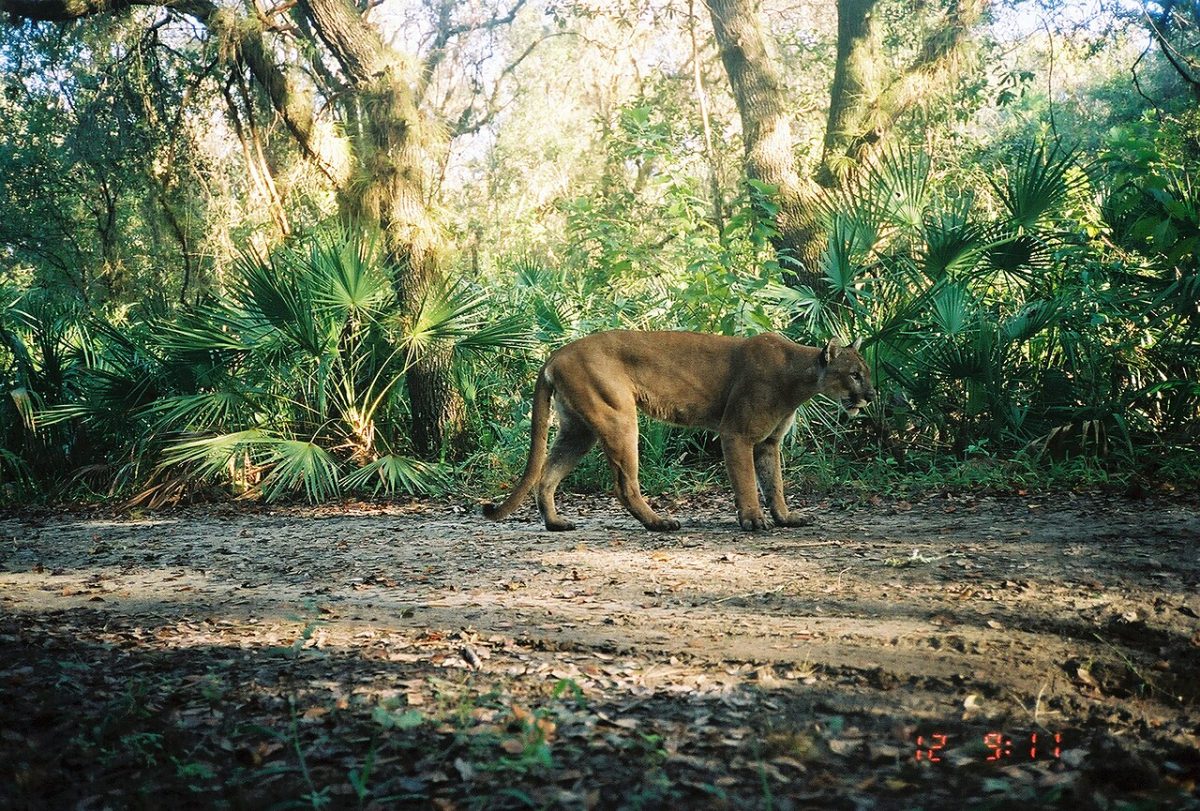
The Florida Panther
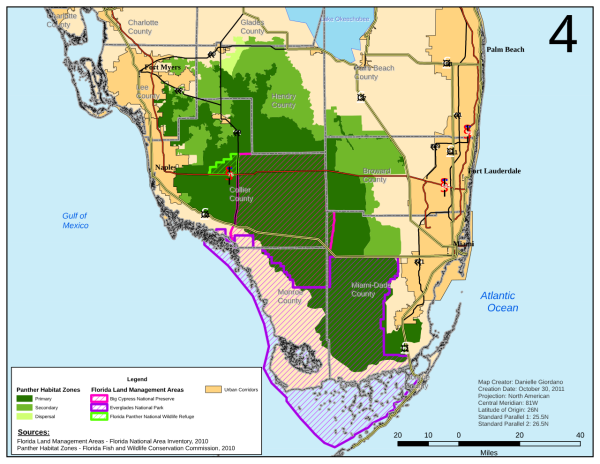
Photo credit to Peacheedolphin via Wikipedia Commons under Wikipedia Commons License’
The legal battle falls squarely within the home range of one of the rarest mammals in North America. With an estimated population of only 120 to 230 adults left in the wild, the Florida panther remains firmly anchored to the federal endangered species list, according to the National Wildlife Federation. Today, the species occupies no more than 5 percent of its original historic range across the southeastern United States. Because nearly all surviving individuals live in Southwest Florida, primarily throughout the undeveloped corridors of Collier County, the expansion of the Town of Big Cypress places their survival at immediate risk.
Panthers require enormous, unbroken territories to live, with a single animal’s home range often covering over 200 square miles. When these critical pathways are interrupted by modern subdivisions, habitat fragmentation occurs, driving a sharp increase in human-wildlife conflict and vehicle collisions.
Collier County consistently records some of the highest numbers of panther deaths in the state. According to data from the Florida Fish and Wildlife Conservation Commission, dozens of panthers die annually from
vehicle strikes, with several deaths already confirmed in the opening months of 2026 alone—a problem conservationists argue will worsen exponentially with increased traffic.Based on current wildlife science, maintaining the total area and functional integrity of existing home ranges within the panther’s designated “Primary Zone” is essential to preventing extinction. Biologists maintain that any proposed development in these areas must result in a net-zero loss of the landscape’s carrying capacity.
However, plaintiffs note that regulatory decisions have significantly hindered these recovery efforts. From 2009 to 2025, over 29,000 acres of panther habitat were completely lost to projects that escaped federal review. The current project under fire will permanently destroy an additional 4,909 acres of habitat, primarily located within that critical Primary Zone.
Growth or Conservation
For environmental groups, the federal lawsuit represents a final, systemic attempt to slow habitat destruction before irreversible damage occurs. Specifically, the suit challenges the 2025 Biological Opinion (BiOp) issued by the U.S. Fish and Wildlife Service, which concluded the project would not jeopardize the species despite acknowledging that widespread habitat loss threatens its survival.
Linguistically and scientifically, conservationists argue the BiOp is fatally flawed. They contend that the federal review focused strictly on habitat quantity while ignoring quality, connectivity, and cumulative environmental effects. Furthermore, the federal assessment relied on an outdated methodology that could support only an estimated population of 90 panthers, far below the official threshold required for a stable recovery.
Matthew Schwartz, Executive Director of the South Florida Wildlands Association, expressed the gravity of the situation plainly, stating he believes that “Town of Big Cypress, due to its immense size and location in some of the most important remaining panther habitat left in Florida, will jeopardize both the continued existence as well as the chances of recovery for the Florida panther.
According to Schwartz, the current trend of “leapfrog development” bypasses existing urban zones and introduces dense, cookie-cutter suburbs into spaces currently devoid of human population. “Sprawling growth is fragmenting existing panther habitat on public and rural lands by expanding roadways and putting many thousands of additional vehicles in the heart of the rural areas,” Schwartz warns, creating a landscape that is increasingly lethal for wildlife to navigate.
At the same time, the reality of Southwest Florida’s intense demographic shift looms large. Collier County has experienced a 29.44% population growth since 2010, intensifying the pressure on local government to provide housing, roads, schools, and sustainable economic development. Developers and county officials maintain that mega-projects like the Town of Big Cypress are necessary to absorb future residential demands while systematically incorporating large-scale environmental protections that small, piecemeal developments cannot offer.
Advocates counter that sustainable growth should mean growing vertically within the existing urban core and expanding mass transit, rather than converting agricultural zoning into sprawling suburbs 30 miles east of downtown Naples.
Compounding the problem is a shifting legal landscape in Florida that environmentalists say leaves public land vulnerable. State legislative shifts, such as the 2023 “loser pays” law, require citizens or environmental groups who lose a zoning challenge to cover the legal expenses of the county and developers—costs that can quickly skyrocket into the millions. This, combined with the historical underfunding of conservation acquisition programs like Florida Forever, has left advocacy groups relying heavily on the federal courts as their last line of defense.
The federal lawsuit may ultimately determine whether stricter environmental review processes will be mandatory before future development projects can proceed in sensitive habitats. But beyond the courtroom, the debate has already exposed a larger, systemic question facing the community—one with no easy resolution.
How much growth can Southwest Florida absorb before the landscape and animals that once made it unique no longer exist at all?