Determining which high school a child will attend is a pivotal moment in a child’s future, one that can determine their opportunities and long-term success. Many families’ first instinct is to look at school rankings to help them make their choice, trusting them to properly disclose a school’s information.
However, the reality is far more complicated. Many reviews inadequately represent the variety of facts essential to the education a child can receive; facts that are essential to the school’s academic environment. Consequently, they can mislead families and limit students’ opportunities before even entering high school.
U.S. News Ranking Methodology
“U.S. News & World Report is a multifaceted digital media company dedicated to helping consumers, business leaders, and policy officials make important decisions in their lives.” This organization is a widely referenced source for ranking schools. These rankings aim to provide students, families, and educators with comparative data on academic quality and school performance.
U.S. News ranks schools based on five categories: graduation rate (10%), state assessment proficiency (20%), state assessment performance (20%), college readiness (30%), and college curriculum breadth (10%).
The graduation rate is the percentage of 9th graders who entered the school and graduated after four consecutive years. This is a factual indicator of a school’s educational quality, student support, and overall environment.
State assessment proficiency in core subjects—mathematics, reading, and science—reflects how well students demonstrate mastery of the state’s academic standards. The accumulated scores from these assessments combine the results of students across schools, districts, and states to provide a broader picture of overall achievement levels. As a result, a school’s proficiency in state assessment is heavily considered among the U.S. News high school rankings.
U.S. News uses the state assessment performance ranking to evaluate how state assessment scores align with its expectations, while also accounting for the percentages of students who identify as Black, Hispanic, or from low-income backgrounds. This provides a broad perspective on students’ capabilities based on their school and socioeconomic background.
The college readiness index displays how seniors perform on advanced academic measures, through Advanced Placement (AP) or International Baccalaureate (IB) exams. This metric reports the proportion of students who take and pass at least one of these exams, with passing weighted three times more heavily than simply taking the class. Therefore, it is an indicator of how effective a school’s rigorous curriculum prepares students for college-level coursework.
Finally, the college curriculum breadth index, displays the proportion of seniors who took and passed an AP or IB assessment more than once, with a maximum of four exams. Once again, passing an exam is worth three times as much as taking the class and failing the exam.
This ranking criterion is greatly influenced by test scores, specifically, AP and IB scores. These programs, while valuable for education, are not the sole ways to determine college readiness. There are a variety of other programs that schools can offer in order to prepare a high school student for higher education.
What is the AICE program?
Over the past few years, one educational curriculum has taken the world by storm, rightfully earning a place in academia. This program, the Advanced International Certificate of Education (AICE), is administered by the University of Cambridge International Examinations in England.
Each course consists of two separate levels of difficulty: AS-level and A-level. AS-level courses consist of college-level course work examinations. MIA also offers A-level courses which cover the same subject matter with more in-depth and challenging examinations, which allows students to earn an additional credit towards their AICE diploma.
As of today, the AICE program is at an all-time high, being implemented in hundreds of schools across the United States. According to the University of Cambridge International Examinations and Cambridge International’s official U.S. higher education policy database (2025), the AICE program is now recognized by 1,039 U.S. institutions for admission or credit consideration. Furthermore, the high school program is offered in 15 states: Arizona, Florida, Indiana, Kansas, Kentucky, Maryland, Mississippi, Nebraska, New York, North Carolina, North Dakota, Pennsylvania, South Carolina, Virginia, and Washington.
Bright Futures Scholarship
The AICE diploma is one of the main ways a student can achieve the Bright Futures Scholarship. The scholarship covers in-state college tuition for eligible students. This scholarship allows students to attend public colleges that might otherwise be unavailable to them. Bright Futures recognizes the AICE Diploma, AP Capstone Diploma, and the IB Diploma, This indicates that all three curricula have similar academic demands and rigor.
Bright Futures takes a significant financial burden off families’ shoulders. MIA senior, Jonathan Juels, said that “it allows me to focus on academic success rather than worry about college debt when trying to get into UF.”
Overall, Cambridge’s AICE program provides students with an education that is equal to, if not stronger than, that of college-level courses. The rise of the AICE program has become undeniably widespread across colleges nationwide. The AICE program effectively provides a strong indicator of students’ capabilities, alongside creating additional opportunities, specifically for the economically disadvantaged, who often face barriers to higher education.
MIA’s AICE Classes
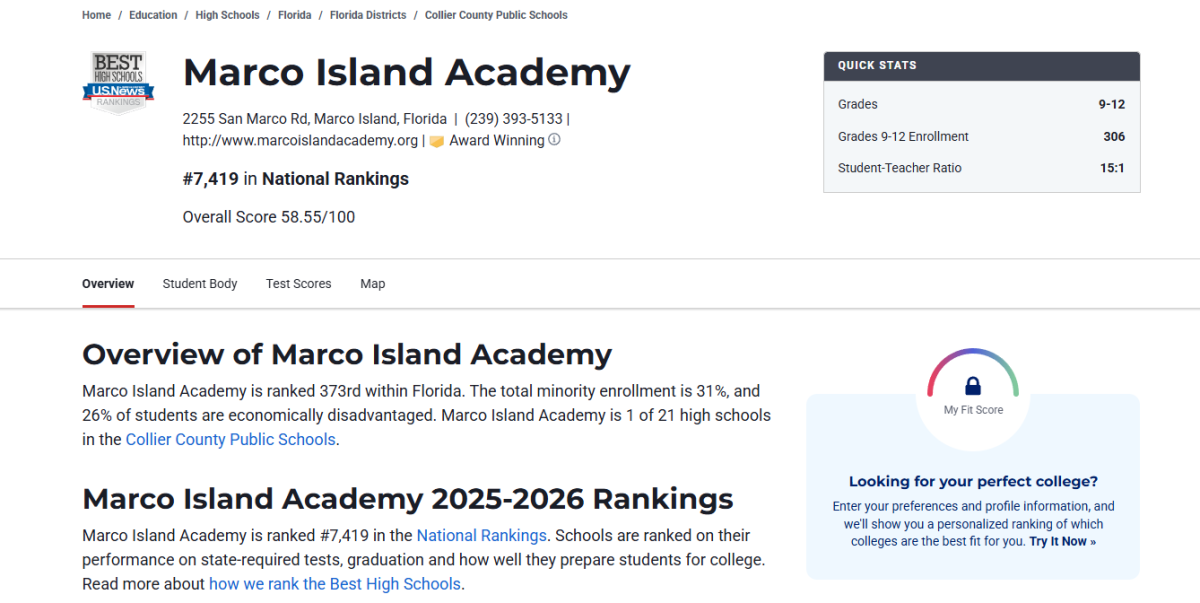
With all of this in mind, it is essential to mention MIA’s ranking. Currently, MIA is ranked 373rd in the state of Florida and 9th in Collier County, with an overall score of 58.5 out of 100. However, this ranking does not take into account the AICE Cambridge program, which prevents MIA from earning up to 40 additional points.
If AICE classes were considered, MIA’s ranking would improve drastically. MIA excels in every one of the AICE classes offered. In five out of six A-Level classes offered at MIA, MIA students achieved higher pass rates than the national average. Additionally, across all nine AS-Level courses, MIA students also outperformed the national average.

AICE Global Perspectives is a required class that students must take and pass to receive their AICE Diploma. In 2025, 48 students took the AS-level global perspectives and research exam. 97.9% of MIA students passed, compared to a national pass rate of 77.4%. Furthermore, in the past 10 years, Global Perspectives at MIA has maintained a pass rate of 97% or higher.
This pattern continues throughout nearly every course. For example, A-level Psychology MIA had a 100% pass rate, compared to a national pass rate of 58.5%. In A-level history, MIA has a 100% pass rate above C, compared to a national 18.7%, and in AS-level mathematics, MIA more than doubles the national pass rate, with a C pass rate of 42.9% compared to 15.5% nationally.
Specifically, in the class of 2024, 59.7% students earned at least one AICE credit towards their diploma. The class of 2025 had 67.5% students achieve that same standard. These statistics directly align with the U.S. News “College Readiness Index.”
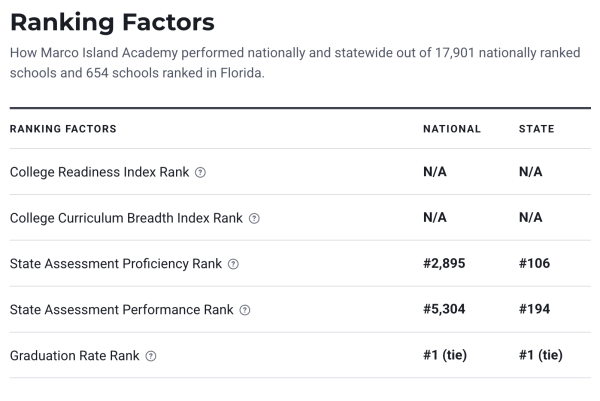
However, MIA is currently ranked “N/A,” eliminating 30 possible points from the school’s ranking as a result of not offering AP or IB courses. Overall, this leaves schools that do not offer AP or IB courses at an automatic disadvantage according to their ranking system.
Similarly, this pattern continues in the “College Curriculum Breadth Index Rank.” The same rationale of AICE not being included, MIA is once again ranked as “N/A,” eliminating 10 additional points from the possibility of MIA’s ranking.
The breadth index has the same issue as the college readiness index, despite statistics from MIA’s AICE program that clearly match the standards for which the index was designed. In the senior classes of 2024 and 2025, 44% of the seniors achieved four or more AICE credits during their high school years. MIA students not only took but also passed the exam, which is considered greater than those who simply take the class, allowing MIA to provide college readiness for their seniors through the AICE program.
This data directly reflects MIA’s college readiness, which accounts for 40 out of 100 points in this ranking. By excluding AICE from its college readiness measure, the ranking system significantly lowers the school’s overall score, despite MIA’s clear success in preparing students for college.
This long-term success is demonstrated in studies conducted at both the University of Florida and Florida State University, which show that first-year college students who completed a Cambridge AICE program earn higher GPAs than their AP and IB counterparts. This suggests that MIA students are, in fact, more college-ready upon graduation than students from schools without AICE. However, by omitting AICE from its evaluation, U.S. News presents a very different picture.
One of MIA’s alumni agreed with the sentiment. Nick Figueroa, who graduated with the class of 2017, reflected on how the AICE program prepared him for life after graduation, explaining that AICE Global was especially valuable because “it’s all about time management and working on bigger projects, because you’re going to have to write a paper and make a presentation at some point in your college career.”
State Testing
Not only does MIA excel within the AICE program, but it also demonstrates strong academic performance on state testing. As per the U.S. News’ ranking criteria, state tests play a pivotal role in determining the rank for any school.
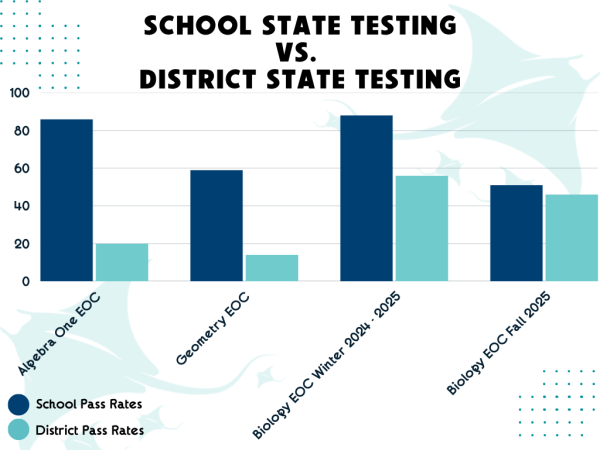
MIA students are excelling in mathematics, science, and reading.
During the winter of 2024-25, MIA students achieved an 86% overall average of a level three or higher for the Algebra One EOC, a drastic increase compared to the district average of 20%. In addition to mathematics, students at MIA received a 59% average for a level three or higher for the Geometry EOC; meanwhile, the average for the district remains at 14%.
Furthermore, U.S. News ranks science state tests equally, and MIA continues to perform exceptionally well. During the winter of 2024-25, MIA’s pass rate was 88% for the Biology EOC, well above the district average of 56%.
Moreover, in the latest FAST ELA Reading exam administered in the fall of 2025, 51% of MIA’s freshmen earned a passing score on the exam with a level three or higher, surpassing the district average of 46%.
Graduation Rate
One important thing to note is that MIA prioritizes success and gives students opportunities to learn, grow, and pursue higher education or a career. It is tied for first with a number of schools in Collier County with a 100% graduation rate.
Final Thoughts
It is time for U.S. News to recognize the AICE program within its ranking methodology, to ensure that all schools receive a fair, accurate, and well-deserved evaluation based on a complete picture.
On multiple occasions, MIA Principal Melissa Scott has reached out to U.S. News regarding the current poor ranking due to inaccurate factors, even requesting to be removed from their list. However, every time, she has been ignored.
U.S. News inaccurately represents schools across the country by relying on outdated metrics that overlook many rigorous academic programs. This both distorts public perception and undermines the hard work of students, teachers, and communities whose achievements fall outside the narrow scope of the system they continue to use.
When upcoming generations are selecting a high school, a number on a list that knowingly misrepresents a school’s capabilities should not be taken into account, especially for such an impactful choice that defines and molds a child’s future.
(This article was edited for clarity on February 27, 2026) .